A tile adhesive supplier must do more than keep bags on a shelf: the recommendation has to match the tile, substrate, exposure, installation method, and project schedule. By the end, you will have a practical way to compare classifications, technical documentation, delivery controls, site support, and the true installed cost before placing an order.
Key takeaways
- Ask for technical data sheets, safety data sheets, batch traceability, and written application guidance.
- Match EN 12004 classification to tile absorption, size, moisture, movement, and exposure.
- Confirm substrate preparation, primer, waterproofing, grout, and movement-joint compatibility.
- Compare coverage, wastage, delivery reliability, technical support, and failure risk—not bag price alone.
Start with the supplier’s technical and fulfilment controls
Qualify the tile adhesives supplier before comparing individual products. Ask for technical support that reviews tile material, dimensions, absorption, substrate, moisture condition, service temperature, traffic, chemical exposure, wet-area details, and movement joints—not a recommendation based on tile size alone.
Require a current technical data sheet, safety data sheet, conformity or test documentation, written limitations, and installation instructions. The documents must state where the adhesive is unsuitable, including substrate and exposure limits.
Check stock continuity and delivery lead time, minimum order rules, and whether one batch can cover a large installation. Get the supplier’s process for shortages, damaged bags, wrong products, and replacement claims in writing.
Inspect every bag for a batch or lot number, manufacture date, printed expiry, storage conditions, pallet protection, and first-in/first-out handling. Cementitious adhesive can absorb moisture and form hardened lumps before expiry; reject torn, damp, or lumpy bags.
A credible supplier records the delivered batch and investigates failures instead of directing every complaint back to the installer. For an unusual tile, substrate, or exposure, request a sample bag or complete a site trial before ordering.
Pre-order checklist:
- Confirm technical review and complete documents.
- Confirm batch availability, minimum order, and delivery date.
- Check packaging, storage, and batch traceability.
- Agree shortage, damage, wrong-product, and replacement procedures.
- Record the approved product, batch, application limits, and trial result.
Match the adhesive classification to the tile and exposure
A claim earns trust when it names the complete tested class. Under EN 12004 and ISO 13007-1, C1 means normal cementitious adhesive, C2 improved cementitious adhesive, T reduced vertical slip, E extended open time, F fast setting, S1 deformable, and S2 highly deformable.
Request the full notation, such as C2TE S1, with test evidence—not merely “polymer modified,” “premium,” or “flexible.”
| Product classification | Installation decision | Check before approval |
|---|---|---|
| Internal dry walls and floors | Select the class for the tile, substrate, and crew pace | Confirm slip, open time, bed thickness, and tile weight |
| Exterior walls, balconies, and façades | Use a class and system rated for weather and movement | Verify water exposure, temperature, façade substrate, and movement joints |
| Wet rooms and heated floors | Match the adhesive to persistent moisture or thermal movement | Confirm membrane compatibility, service temperature, and deformability |
| Movement-prone substrates | S1 or S2 may be needed, but does not replace joints | Require the complete system design and structural-joint treatment |
The listed Kerakoll H40 Gel Grey is the supplied example carrying a C2TE-S1 classification; other product descriptions do not establish equivalent classifications. For North American procurement, ask whether the claim is ANSI A118.1, A118.4, A118.11, or A118.15 and read its substrate limits.
No class automatically approves porcelain, vitrified tile, natural stone, glass, resin-backed tile, mosaics, or large-format slabs. For pale, translucent, moisture-sensitive, or resin-backed assemblies, demand a product-specific compatibility statement, white or rapid-drying mortar guidance, epoxy advice, or a test panel.
Check the substrate, system compatibility, and size limits
A recommendation is usable only if it names the surface limits. Ask for written figures for concrete curing age, residual moisture, substrate temperature, pH or alkalinity, bed thickness, tile size and mass, open time, adjustment time, and flatness.
1. Set screening limits before ordering: cementitious concrete or screed at least 28 days old, residual moisture no higher than 2.0% CM; calcium-sulfate screed no higher than 0.5% CM; substrate temperature 5–35°C; pH below 10 where the system requires it; bed thickness 2–10 mm; flatness within 3 mm under a 2 m straightedge.
Require the supplier to confirm every figure for the selected adhesive.
2. Identify the substrate precisely. Calcium-sulfate screeds, gypsum board, timber or plywood, heated screeds, membranes, and old tiled surfaces can require different primers, moisture limits, adhesive classes, or mechanical preparation. Do not accept a recommendation based only on tile size.
3. Complete substrate preparation by removing dust, laitance, oil, curing compounds, and loose material. Treat cracks, correct unevenness with a compatible levelling product, and perform moisture testing. Obtain written primer and waterproofing compatibility; adhesive is not a waterproofing or crack-isolation system unless specifically tested and approved for that use.
4. For showers, balconies, wet rooms, or façades, request the full detail for membrane, corners, penetrations, drains, mortar, grout, and movement joints. Provide soft joints at perimeters, changes of plane, penetrations, structural joints, and project-required field locations. S1 flexibility does not replace sealant joints or structural-joint treatment.
Demand a method statement that proves coverage in practice
Require a written method statement that proves the crew can achieve a durable bond, not one that repeats a bag claim or nominal notch size. It must state water dosage, mixing time, slaking time, remixing rules, pot life, open time before skin formation, adjustment time, temperature limits, and minimum and maximum bed thickness.
- Prohibit extra water, retempering after pot life, and spreading more mortar than the crew can tile within open time. Select the notch by tile and substrate; comb in one direction, and use back-buttering for large-format or ribbed porcelain.
- Include a coverage check: periodically lift freshly placed tiles and inspect the mortar. Require at least 80% contact in interior dry areas and at least 95% in wet or exterior areas, with mortar supporting perimeters and corners.
- Do not treat notch size as proof of coverage. Substrate flatness, tile warpage, back ribs, mortar rheology, and troweling direction change the result.
- Convert consumption into actual bag requirements after a site trial. Allow for bed thickness, unevenness, back-buttering, tile profile, and waste; 1.2 or 1.3 kg/m² per millimetre is not a project quantity by itself.
| Product pace | Fast-setting mortar | Standard-setting mortar |
|---|---|---|
| Return to service | Earlier grouting or traffic | Longer waiting period |
| Crew control | Shorter mixing, adjustment, and cleanup windows; hot weather increases risk | More working time for placement and correction |
| Best fit | Small controlled areas with a fast, experienced crew | Larger areas or crews needing longer open time |
Match the choice to tile size, production rate, temperature, cleanup time, and required return-to-service time.
Compare the complete supply offer, not the lowest bag price
Choose the supplier whose complete offer lowers installed cost, not the one with the cheapest bag. A cementitious adhesive suits many mineral-tile installations when its class and substrate limits fit. A ready-mixed dispersion adhesive needs a product-data use case and is a poor default for persistent moisture or heavy-duty exposure.
| Option | Strength | Cost and risk to compare |
|---|---|---|
| Cementitious adhesive | Broad suitability when correctly classified | Bags per square metre, bed thickness, waste, labour speed and failure risk |
| Dispersion adhesive | Convenient for documented compatible interior applications | Moisture limits and slower grouting or drying |
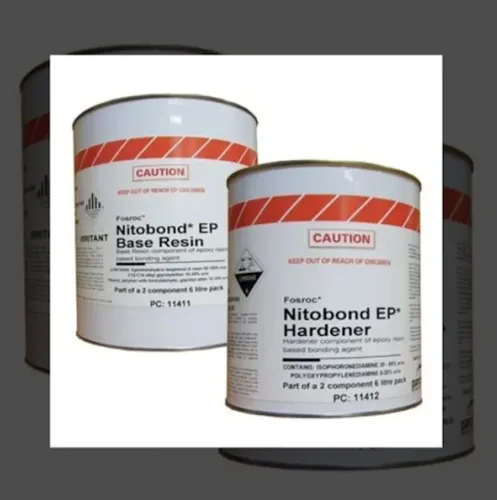
| Epoxy adhesive | Demanding chemical or moisture exposure | Higher material cost, strict mixing, short working window and difficult cleanup |
| Cement-sand mortar | Traditional thick-bed bedding | Not a tested thin-bed substitute for large porcelain, membranes or demanding exterior work |
Ask for coverage at the specified trowel and thickness, then verify it through a site trial. Include waste, labour speed, grouting delay, cleanup and replacement costs in the installed cost.
Require test data for tensile adhesion after dry storage, water immersion, heat aging and freeze-thaw exposure. Check slip, open time, transverse deformation, pot life and adjustability. Dolfin Projects can help Gujarat contractors and industrial buyers review project data, match the product to its documents, arrange a trial and handle batch or replacement issues.
Approve the supplier only when the recommendation, documents, logistics and post-delivery response are written down.
Related products
 | Fosroc Waterproofing Chemical Tileglue 4.0 Floor Tile Stone Adhesive Supplier Packaging Size 20 kg Tile On Tile Yes Packaging Type Bag Country of Origin Made in India Form Powder Description: Highly polymer modified,... View product → |
 | Tile Adhesive Supplier Packaging Size 20 kg Country of Origin Made in India Color grey,white Coverage 1,2kg/m 2 per mm of thickness Thickness from 2 to 10 mm... View product → |
Frequently asked questions
What technical and fulfilment controls should a tile adhesives supplier provide?
Ask for current technical and safety data sheets, batch traceability, storage instructions, stock status, delivery commitments, and application support.
How do you match tile adhesive classification to the application?
Check the adhesive classification under EN 12004 against tile material, absorption, dimensions, service conditions, wet exposure, traffic, and movement.
What substrate and compatibility checks matter before selecting tile adhesive?
Confirm substrate strength, flatness, cleanliness, moisture condition, primer requirements, waterproofing compatibility, tile size limits, and movement-joint details.
What should a tile adhesive method statement include?
Require substrate preparation, mixing water, open time, notch size, back-buttering, working sequence, coverage checks, curing, and joint-treatment instructions.
How should you compare tile adhesive suppliers beyond bag price?
Compare stated coverage, wastage, packaging, delivery reliability, technical support, compatible system components, labour effort, and the cost of remedial work.
Related products
 | Waterproofing Chemical FC Tileglue 1.0 Tile Adhesives, 20 Kg Supplier Packaging Size 20 kg Packaging Type Bag Grade Standard Chemical Strength High Material Compatibility Ceramic Country of Origin Made in India... View product → |
 | Tile Adhesive Firstchoice FC Tileglue 2.0 Tile Adhesive, 20 Kg Supplier Packaging Size 20 kg Packaging Type Bag Grade Standard Industrial Strength High Country of Origin Made in India Polymer modified single... View product → |
 | Tile Adhesive Firstchoice 20 Kg Tileglue 3.0 Tile Adhesive Supplier Packaging Size 20 kg Packaging Type Bag Grade Standard Industrial Strength High Material Compatibility Ceramic Country of Origin Made in... View product → |
 | Tile Adhesive Supplier Packaging Size 25 kg Country of Origin Made in India Application High Deformable SAS Technology Adhesive for External Tile & Stone Work. View product → |