A leaking crack is not automatically a PU injection job: dampness, shrinkage, structural failure, and a moving joint require different decisions. By the end, you will be able to diagnose the defect, compare PU foam with epoxy and other repair methods, and brief a supplier or applicator without relying on crack width alone.
Key takeaways
- Trace active flow and hydrostatic pressure before selecting resin.
- Use flexible PU foam where cracks move or water remains active.
- Install injection ports at intervals and inject from the lowest point upward.
- Control pressure to avoid widening cracks or damaging surrounding concrete.
Diagnose the Water Path Before Choosing a Resin
Trace the water, not just the visible crack. Active water leakage produces droplets, a stream, or changing flow under hydrostatic pressure; dampness leaves staining, salt deposits, or a cool dark surface without measurable flow. A dry crack is not automatically harmless.
| Condition | What to inspect | What it indicates |
|---|---|---|
| Active water leakage | Flow rate, pressure, entry point, and whether flow changes after rain or pumping | A water-reactive injection system may be needed to stop ingress |
| Dampness | Moisture pattern, salts, condensation, and nearby joints or penetrations | The source may be elsewhere; sealing the stain alone can fail |
| Shrinkage cracks | Fine, stable, usually surface-level lines in young or drying concrete | Usually nonstructural; confirm that the concrete remains sound |
| Structural cracks | Displacement, widening, diagonal patterns, exposed reinforcement, or load-related location | Requires structural assessment before selecting a sealing resin |
| Movement joints | A designed gap, joint sealant, repeated opening and closing, or differential movement | Needs joint detailing or a flexible system, not rigid crack filling |
Map connected cracks, cold joints, honeycombing, pipe interfaces, and voids behind the concrete. Record crack width, movement, concrete soundness, water pressure, chemical exposure, and whether the source can be stopped externally. Hydrophobic PU foam limits water uptake and suits rapid leak stopping; hydrophilic PU depends on moisture to swell.
Neither replaces structural repair or a joint designed for movement.
Match PU Foam to the Crack’s Water and Movement Conditions
Active water ingress, voids behind concrete, honeycombing, and leaking pipe penetrations are strong cases for PU foam injection. It fills the water path and stops flow, but it does not restore structural continuity. Choose by water, movement, loading, and concrete condition—not crack width alone.
| Option | Choose it when | Main limitation |
|---|---|---|
| PU foam injection | The crack or void is wet and the immediate goal is leak stoppage. Hydrophobic PU expands with limited water uptake; hydrophilic PU swells in continued moisture and suits persistently wet paths when wet-cycle performance is documented. | Foam can lose contact under substantial movement or hydrostatic pressure and is not a structural bond. |
| Epoxy injection | A clean, dry, dormant crack needs bonding and permanent load transfer. | Rigid epoxy injection is a poor choice for active leaks or cracks that open and close. |
| Flexible resin | The crack leaks and remains subject to cyclic movement after water entry is controlled. | Confirm cured flexibility, adhesion to wet concrete, chemical resistance, and the movement range. |
| Joint detailing | The defect is a wide movement joint, construction joint, or interface that needs a sealant, waterstop, backer, or drainage detail. | Injecting foam alone does not accommodate designed joint movement. |
| Structural repair | Settlement continues, concrete is unsound, reinforcement is affected, or the surface must carry restored loads. | Resin injection cannot replace engineering assessment, load relief, concrete removal, or strengthening. |
Ask the supplier to state the resin’s limits for water pressure, movement, chemical exposure, and repeated wetting. If the crack connects to a cold joint or reinforcement interface, stopping the visible leak may require secondary injection, external water management, or structural repair.
Specify the Injection System, Not Just “PU Grout”
Ask for a complete system, not a drum labelled “PU grout”: the resin, packers, hoses, injection pump, mixing head, cleaner, and operating procedure must work together. Request these details:
- The declared intended use and performance classification under the applicable local adoption of EN 1504-5: filling, ductile or flexible injection, or swelling injection.
- Resin viscosity, component ratio, reaction time at site temperature, solvent compatibility, and recommended packer size.
- Confined expansion, density, adhesion, elongation, water-reaction, and wet/dry-cycle results. Free-rise expansion in a cup does not predict behaviour in a fine crack; excessive expansion can create weak, low-density foam.
- Pump type, maximum working pressure, hose pressure rating, injection rate, flushing method, and clean-up solvent.
- A current technical data sheet, safety data sheet, batch traceability, shelf life, and trial or commissioning procedure for high-viscosity or fast-reacting resin.
| Resin type | Water behaviour | Ask before choosing |
|---|---|---|
| Hydrophobic PU foam | Expands with limited water uptake; suited to rapid leak stoppage | Confined expansion and cured-foam durability |
| Hydrophilic PU resin or gel | Absorbs water and swells; depends on continued moisture | Wet-cycle performance and movement tolerance |
Match reaction time to flow and temperature: fast water can foam at the entry point, while a slow resin can wash out. Dolfin Projects can help compare the supplier’s technical data sheet with the pump and site conditions, rather than treating “PU grout” as a specification.
Related products
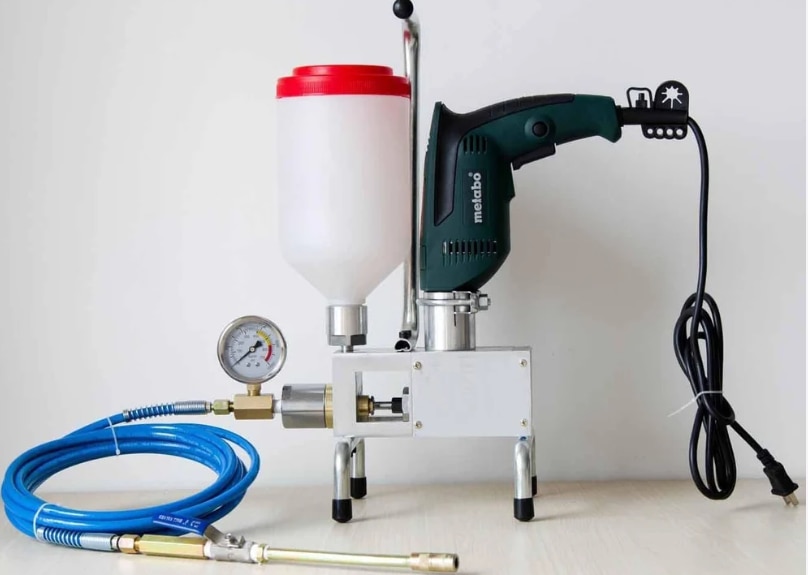 | Epoxy Grout Supplier Method Of Grouting Injection Grouting with Machine Injection Grouting Type PU Applicable Area Wall Property Type Commercial Ceiling/Wall... View product → |
 | Normet Products suppliers Packaging Size 600 ml Packaging Type pack Color White Application Industry Joint filling Surface Of Application Concrete Brand Fosroc Grade... View product → |
Prepare Ports and Inject From the Lowest Point Upward
Begin by exposing the full crack and marking injection ports from the lowest wet point to the highest visible extent. Remove laitance, paint, dirt, and loose concrete so the crack path and surrounding surface are visible.
1. Drill holes that intersect the crack rather than stopping beside it. Angle each hole toward the crack centreline, then flush out drilling dust. Set port spacing according to crack width, depth, concrete condition, and water travel; closer spacing is needed where the crack branches or leaks heavily.
2. Install mechanical packers firmly in the cleaned holes. Tighten them enough to resist pumping pressure, but do not crush weak concrete around the hole. Check that each packer accepts the injection coupling before sealing the surface.
3. Seal the crack face between packers with a compatible surface seal. Close visible gaps, honeycombing, and loose edges so resin does not escape into the room. This surface seal is only a containment detail; it does not replace injection into the crack.
4. Follow the injection sequence from the lowest accessible port upward. Pump slowly until resin reaches the next port, appears at an adjacent crack point, or reaches controlled refusal; close that port and move upward. Watch for leakage, packer movement, and unexpected surface lifting.
5. After curing, remove or cut back the packers, fill the holes with compatible repair mortar, and finish the sealed surface flush with the concrete. Clean away foam without gouging the repair or hiding an open crack.
Control Pressure and Verify the Repair Without Creating New Damage
Start with low injection pressure, not a target copied from a datasheet: pressure is controlled against the concrete’s condition and the water path. Use a calibrated gauge, pump in short increments, and increase only when resin reaches the next port or flow reduces without surface distress.
The pressure needed to overcome hydrostatic pressure is not permission to exceed the concrete’s soundness.
Stop pumping if the gauge rises sharply while no port accepts resin, if resin appears at an unintended location, or if the surface lifts or the concrete sounds hollow. These signs point to an obstruction or loss of bond; forcing more material can widen the crack and redirect water behind the repair.
Record pressure, volume, port sequence, and observed resin travel.
Allow the foam to cure for the period stated in the product data, then carry out leak testing under water exposure comparable to the original condition. Inspect the repaired face and nearby connected paths, not just the injection ports.
Dampness, a new wet spot, or water emerging at the next joint means the visible opening was not the entire flow path.
Repair verification requires a documented result: location, date, test condition, pressure or water head, and photographs before and after. A dry surface immediately after pumping is not proof of permanence. If leakage returns under hydrostatic pressure or crack movement, specify secondary injection, flexible resin, drainage, or external waterproofing instead of raising injection pressure blindly.
Frequently asked questions
How do you diagnose a leaking crack before choosing PU grout?
Trace the water path and distinguish active flow from dampness, staining, salt deposits, or a cool dark surface. Check whether hydrostatic pressure changes the leakage.
How do you match PU foam to crack conditions?
Choose the resin according to water flow, crack movement, and whether the repair needs flexible sealing or a more rigid fill.
Why specify the injection system instead of asking for PU grout?
Define the resin, accelerator or catalyst, injection ports, packers, mixing equipment, pressure range, and curing requirements so the system suits the repair.
How should injection ports be prepared and used?
Expose and clean the crack, install ports at suitable intervals, seal the surface between ports, then inject from the lowest port upward while monitoring return flow.
Related product
 | Fosroc Waterproofing Chemical Fosroc Renderoc Plug Waterproofing Chemical Supplire Brand Fosroc Usage/Application Construction Packaging Size 15 kg Category Waterproofing Coating Temperature 10 Degree Celsius Packaging Type... View product → |